AI is reshaping contact centers from cost-heavy support hubs into revenue-driving, customer-obsessed experience engines. When implemented thoughtfully, IA para centros de contacto does far more than deflect calls—it accelerates resolutions, personalizes every interaction, and gives agents superpowers in every conversation. For businesses looking to understand the strategic impact of AI across the customer lifecycle, the Metapress guide to AI in customer journey management offers essential insights into how AI enables seamless, omnichannel experiences.
The potential of call center AI grows when paired with advanced contact center technology, enabling faster data access and smoother workflow automation. Integrating AI with high performance computing allows agents to analyze customer interactions in real time and predict outcomes, giving every conversation more impact. Businesses can also improve engagement by applying online marketing strategies that align AI insights with campaign performance, ensuring messages reach the right audience at the right time.
AI-powered insights can optimize call handling and campaign management, especially when combined with digital marketing optimization. By prioritizing interactions based on predictive analysis, agents are empowered to deliver personalized experiences that drive customer satisfaction. Financial operations benefit as well, with automated finance solutions that streamline transactions, reduce errors, and provide consistent support in high-stakes environments.
Ultimately, call center AI transforms customer service from reactive support into proactive engagement. By merging intelligent technology, marketing insights, and financial efficiency, businesses can create interactions that feel natural, personalized, and truly humanized—turning every conversation into an opportunity for loyalty, growth, and exceptional experience.
Top 10 Call Center AI Solutions for Modern Contact Centers
Choosing the right call center AI solution can transform customer support from a cost-heavy function into a proactive, revenue-driving part of your business. Here’s a curated list of the leading platforms that empower agents, streamline workflows, and enhance customer experience.
1. Bright Pattern – AI-Driven Contact Center Solutions
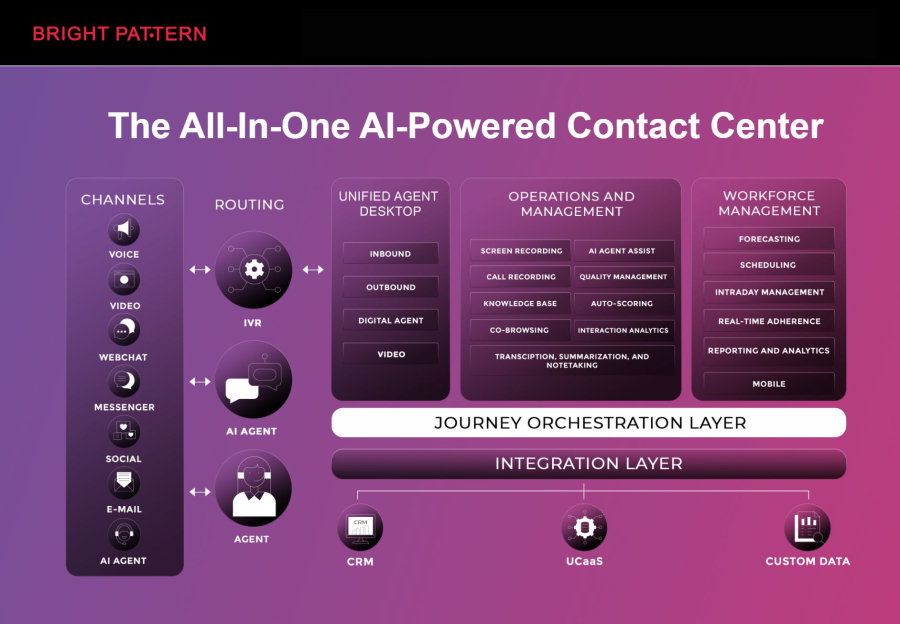
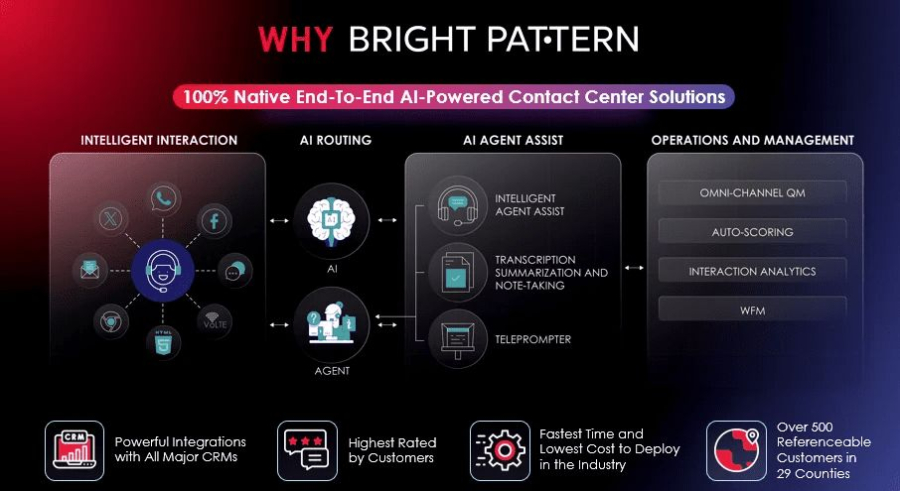
Bright Pattern is a leader in call center AI technology, offering a flexible, cloud-based platform that integrates AI across multiple channels. Businesses can automate routine tasks, improve agent efficiency, and provide personalized customer interactions.
Key features include:
- Omnichannel routing for voice, chat, email, and social media
- AI-assisted agent support with real-time suggestions
- Intelligent workflow automation for faster resolutions
- Advanced analytics for predictive customer insights
- Seamless integration with CRM and marketing platforms
Bright Pattern helps organizations deliver faster, smarter, and more personalized service, making it ideal for modern AI-driven contact centers.
2. Five9 – Cloud Contact Center AI
Five9 provides AI-powered automation, predictive dialing, and advanced analytics, helping agents focus on high-value customer interactions.
3. Genesys Cloud – AI-Powered Customer Engagement
Genesys Cloud leverages AI to route inquiries efficiently, automate routine tasks, and deliver real-time guidance to agents.
4. Talkdesk – Intelligent Call Center Solutions
Talkdesk combines AI with automation and omnichannel support to improve efficiency and enhance the customer experience.
5. NICE inContact – AI Contact Center Platform
NICE inContact offers predictive routing, sentiment analysis, and virtual assistants to optimize call handling and improve satisfaction.
6. Zendesk – AI-Enhanced Customer Support
Zendesk uses AI to provide automated ticketing, predictive responses, and workflow automation for seamless customer interactions.
7. RingCentral Contact Center – AI Integration
RingCentral integrates AI tools to support omnichannel communication, automate routine processes, and provide actionable insights.
8. 8x8 Contact Center – AI-Powered Analytics
8x8 delivers AI-driven analytics, speech recognition, and automation to streamline contact center operations.
9. Cisco Contact Center – AI Virtual Assistants
Cisco’s AI virtual assistants and intelligent routing solutions help businesses reduce wait times and improve customer satisfaction.
10. Avaya OneCloud – AI-Enhanced Support
Avaya OneCloud leverages AI to optimize agent workflows, automate routine tasks, and provide predictive insights to enhance service quality
What Is AI for Contact Centers?
AI for contact centersis the use of technologies like machine learning, natural language processing, and automation to improve how customers interact with brands across channels such as voice, chat, email, and messaging.
Instead of relying exclusively on human agents, AI can understand customer intent, handle routine inquiries, assist agents in real time, and surface insights from every interaction. The result is a modern contact center that is faster, smarter, and more scalable.
Why AI Is a Game-Changer for Contact Centers
AI is not about replacing people. It is about removing friction so both customers and agents can focus on what really matters. When done right, AI delivers powerful business and customer outcomes.
- Faster resolutions:AI can instantly identify intent, surface relevant knowledge, and automate simple tasks, cutting handle times and wait times.
- 24 / 7 availability:Virtual agents provide always-on support, so customers get answers even when human teams are offline.
- Consistent experiences:AI follows rules and best practices every time, reducing variance between agents and channels.
- Lower cost per contact:Automating repetitive interactions frees human agents to focus on complex, high-value cases.
- Empowered agents:Real-time recommendations, next-best actions, and automated after-call work give agents more time to engage with customers.
- Data-driven decisions:AI can analyze every conversation, revealing trends, root causes, and opportunities for improvement.
- Scalable operations:AI absorbs spikes in volume without sacrificing quality, helping you handle peak seasons and campaigns.
Core AI Capabilities in Modern Contact Centers
AI in contact centers is not a single feature. It is a combination of capabilities that work together to enhance every stage of the customer journey.
1. Conversational AI and Virtual Agents
Conversational AIpowers voicebots and chatbots that understand natural language and respond like a human would. They can:
- Answer common questions (for example, order status, account balance, password reset).
- Walk customers through step-by-step processes.
- Collect information before handing off to a human agent.
- Offer proactive assistance based on context or past behavior.
Well designed virtual agents improve self-service rates and reduce friction, while still providing seamless handoffs to human agents when needed.
2. Intelligent Routing and Queue Management
Traditional routing might send calls to the next available agent.AI-powered routinganalyzes customer history, intent, language, and even sentiment to match each interaction with the best available agent or queue.
- Skill-based routing powered by AI ensures experts handle complex inquiries.
- Priority routing ensures VIP customers or urgent issues are handled first.
- Channel optimization can decide whether to handle an inquiry via chat, voice, or messaging.
This leads to faster resolution times, fewer transfers, and higher customer satisfaction.
3. Real-Time Agent Assist
Agent assisttools listen to or read customer conversations in real time and provide suggestions directly to the agent. They can:
- Surface relevant knowledge base articles or policies.
- Recommend next-best actions based on similar past cases.
- Auto-summarize the interaction, cutting down after-call work.
- Prompt agents with compliance or disclosure scripts when needed.
With the right assist tools, new hires ramp faster, experienced agents become more efficient, and customers feel better supported.
4. Sentiment Analysis and Quality Monitoring
AI-driven sentiment analysisevaluates tone, keywords, and conversation patterns to gauge how customers feel during and after interactions. Combined with automated quality monitoring, this can:
- Flag at-risk customers or escalations in real time.
- Highlight coaching opportunities based on actual conversations.
- Identify top drivers of dissatisfaction or churn.
- Provide accurate trends without manually sampling a small subset of calls.
Leaders get a comprehensive view of customer experience and service quality without relying solely on post-contact surveys.
5. Workforce Management and Forecasting
AI also enhances the behind-the-scenes operations of the contact center.AI-powered workforce managementcan:
- Forecast contact volumes more accurately using historical patterns, campaigns, and external signals.
- Optimize schedules to align staffing with predicted demand.
- Suggest ideal shift patterns and skills distribution.
The result is a better balance between service levels, agent workload, and operational costs.
6. Automation of Repetitive Tasks and Back-Office Work
Many contact center tasks are repetitive, rule-based, and ideal for automation.AI and automationcan handle:
- Data entry and updates in CRM or ticketing tools.
- Form filling and case creation.
- Simple order changes or cancellations within defined rules.
- Routine follow-up emails or notifications.
By automating these tasks, organizations reduce errors, accelerate processing, and give agents more time for complex, empathetic conversations.
High-Impact Use Cases for AI in Contact Centers
AI can touch nearly every interaction and workflow in the contact center. Below are some of the highest-impact use cases that organizations often start with.
1. Intelligent Self-Service for Common Inquiries
Virtual agents excel at handling high-volume, low-complexity tasks such as:
- Order, delivery, or appointment status.
- Billing and payment questions.
- Password resets or account unlocks.
- Service availability and basic troubleshooting.
By offloading these interactions to AI, organizations see immediate gains in speed, cost efficiency, and customer convenience.
2. Smart Triage and Pre-Qualification
Even when a human agent is needed, AI can collect and structure information before the handoff. For example, AI can:
- Ask clarifying questions to understand the issue.
- Gather account details and verification data.
- Capture screenshots or attachments in digital channels.
- Classify the inquiry type and urgency.
Agents then start conversations with rich context, reducing repetition for customers and speeding up resolutions.
3. Proactive Service and Notifications
AI can analyze data to anticipate customer needs and trigger proactive outreach, for example:
- Alerting customers about delays, outages, or maintenance before they call.
- Recommending plan changes when usage patterns shift.
- Following up on unresolved issues to ensure successful outcomes.
Proactive experiences reduce inbound volume and build trust by showing customers that you are one step ahead.
4. Sales and Retention Support
AI can turn the contact center from a cost center into a revenue engine by supporting upsell, cross-sell, and retention conversations. It can:
- Surface personalized product or plan recommendations.
- Highlight churn risk signals in real time.
- Suggest offers or scripts tailored to customer value and preferences.
Agents become more confident in value-based selling, while customers receive relevant, timely suggestions that actually help them.
5. Training and Coaching at Scale
AI can automatically review interactions and provide targeted insights for coaching and training, such as:
- Patterns where agents struggle with certain topics or policies.
- Examples of excellent empathy, de-escalation, or sales techniques.
- Compliance adherence and script usage.
This allows leaders to provide personalized coaching plans and celebrate top performers using objective, data-based insights.
AI Capabilities and Business Outcomes at a Glance
The table below maps common AI capabilities to the outcomes they enable in a contact center.
|
AI Capability |
Primary Outcome |
Example Impact |
|
Conversational AI / Virtual Agents |
Higher self-service and faster responses |
Deflects routine contacts while maintaining customer satisfaction. |
|
Agent Assist |
More efficient and confident agents |
Shorter handle times and higher first-contact resolution. |
|
Sentiment Analysis |
Better customer experience management |
Early detection of dissatisfaction or escalation risk. |
|
Intelligent Routing |
Right agent, right interaction |
Fewer transfers and improved resolution quality. |
|
Automation and Workflows |
Lower costs and reduced manual work |
Less after-call work and back-office rework. |
|
Forecasting and WFM Optimization |
Balanced service levels and staffing |
Improved adherence and fewer overstaffed periods. |
Step-by-Step: How to Introduce AI into Your Contact Center
Moving to an AI-enhanced contact center does not need to be overwhelming. A structured approach helps you capture quick wins while laying a foundation for long-term success.
- Clarify your goals.Decide what you want AI to achieve first, such as reducing average handle time, improving self-service, or boosting customer satisfaction.
- Map customer journeys.Identify high-volume, high-friction interactions where AI can remove effort for customers and agents.
- Prioritize quick-win use cases.Start with tasks that are simple, repetitive, and well documented, such as common FAQs or status checks.
- Prepare your data.Ensure customer interaction data, knowledge articles, and processes are accurate and accessible so AI can learn from reliable information.
- Design for human + AI collaboration.Define when AI handles an interaction end to end and when it hands off to an agent with full context.
- Run pilots and iterate.Launch with a limited scope or audience, monitor performance, collect feedback, and refine conversation flows and rules.
- Engage and train agents.Show agents how AI helps them succeed, provide training on new tools, and invite their feedback for improvements.
- Measure, optimize, and scale.Track key metrics, expand to new use cases, and continuously tune models and workflows for better performance.
Key Metrics to Track for AI Success
To demonstrate the value of AI in your contact center, define clear success metrics from the start. Common KPIs include:
- Self-service containment rate:Percentage of interactions fully resolved by AI without human intervention.
- First contact resolution (FCR):How often issues are resolved in a single interaction, with or without AI assistance.
- Average handle time (AHT):Impact of AI on call and chat duration for both customers and agents.
- Customer satisfaction (CSAT) and NPS:How customers feel about AI-assisted and AI-led interactions.
- Agent effort and engagement:Changes in after-call work, workload, and agent feedback on new tools.
- Contact volume and deflection:Shifts in inbound volume as self-service usage grows.
- Cost per contact:Operational savings realized through automation and efficiency.
By tying AI performance to metrics that matter to your organization, you build a strong business case for expansion and continuous investment.
Best Practices for a High-Performing AI-Enabled Contact Center
Organizations that achieve standout results with AI in their contact centers tend to follow a set of common best practices.
- Start with the customer, not the technology.Design AI experiences around customer needs and expectations, focusing on clarity, speed, and empathy.
- Keep humans in the loop.Ensure there is always a clear, easy path to reach a human agent, especially for complex or emotional issues.
- Invest in knowledge management.High quality, up-to-date information is essential for accurate AI responses and effective agent assist.
- Design natural, conversational flows.Use language customers understand, avoid jargon, and test flows with real users.
- Communicate clearly that AI is helping.Let customers know when they are interacting with a virtual agent and what it can do for them.
- Empower and involve agents.Position AI as a supportive teammate, not a replacement. Use agent feedback to improve AI behavior over time.
- Continuously learn and refine.Use analytics and conversation transcripts to identify improvement opportunities and train models regularly.
Future Trends: Where AI for Contact Centers Is Heading Next
AI capabilities continue to evolve quickly, opening up even more possibilities for contact centers. Some emerging trends include:
- More human-like conversations.Advances in natural language understanding are making virtual agents more context-aware and capable of handling multi-turn, complex dialogues.
- Richer personalization.AI will increasingly combine behavioral, transactional, and interaction history data to tailor support and offers in real time.
- Unified experience across channels.Customers will move between voice, chat, and messaging seamlessly, with AI maintaining context and continuity.
- Deeper integration with business systems.AI in the contact center will connect with marketing, sales, and product data to provide a complete, end-to-end experience.
- Even smarter coaching and performance support.Real-time guidance and post-interaction insights will help agents continuously improve, making every conversation better than the last.
As these trends mature, organizations that have already laid a strong AI foundation in their contact centers will be best positioned to deliver standout customer experiences and unlock new sources of value.
Bringing It All Together
AI for contact centers is more than a technology upgrade. It is a strategic shift toward faster, more personal, and more intelligent customer experiences. By combining virtual agents, agent assist, intelligent routing, and automation, organizations can serve customers better while creating a more rewarding environment for agents.
With a clear vision, thoughtful implementation, and a commitment to continuous improvement, AI-enabled contact centers can become a powerful engine for customer loyalty, operational excellence, and long-term growth.
